
- Key Takeaways
- Understanding Cloud Computing
- Key Characteristics of Cloud Computing
- History and Evolution of Cloud Computing
- Cloud Service Models
- Deployment Models of Cloud Computing
- Benefits of Cloud Computing
- Challenges in Cloud Computing
- Cloud Security and Data Protection
- Industry Applications of Cloud Computing
- Future Trends in Cloud Computing
- Summary
Cloud computing delivers IT resources like storage, servers, and applications over the internet. This eliminates the need for on-site hardware and offers flexible, scalable, and cost-effective solutions. This guide covers everything from the basics of cloud computing to its service models and future trends.
Key Takeaways
Cloud computing transforms IT resource management by providing access to virtualized services over the internet, reducing costs and eliminating the need for extensive on-premises infrastructure.
The three main cloud service models—Infrastructure as a Service (IaaS), Platform as a Service (PaaS), and Software as a Service (SaaS)—offer varying levels of control and flexibility for businesses in developing and deploying applications.
Future trends in cloud computing include the rise of serverless computing, investment in public cloud services surpassing traditional IT, and a focus on sustainability, all of which are expected to enhance operational efficiency and drive innovation.
Understanding Cloud Computing

Cloud computing represents a significant shift from the traditional client server model of IT resource management. Unlike the old model where businesses had to invest heavily in on-premises infrastructure, cloud computing enables organizations to access IT resources over the internet, eliminating the need for costly hardware setups and software patching.
At its core, cloud computing leverages virtualization to pool and share resources, allowing for increased infrastructure utilization and reduced costs. This technology facilitates the execution of programs and storage of data on virtual machines and virtual servers rather than on local machines, ensuring availability through backup across multiple machines and regions.
Major cloud providers like Amazon Web Services, Google Cloud, and Microsoft Azure operate on a global network of secure data centers, offering various cloud services that cater to diverse business needs. Whether it’s for international operations or local scalability, cloud computing removes many of the traditional barriers to IT resource management, enabling businesses to focus on their core activities in a data center.
Key Characteristics of Cloud Computing
Cloud computing is defined by several key characteristics that set it apart from traditional IT models. One of the most significant features is self-service provisioning, which allows users to independently manage and provision resources without needing administrative assistance. This autonomy is crucial for businesses that need to scale their operations quickly and efficiently in a cloud computing model.
Another essential characteristic is broad network access. Cloud services are accessible over standardized networks and can be used on various types of devices, from smartphones to laptops, ensuring that resources are available whenever and wherever they are needed. This broad accessibility is a game-changer for businesses with remote teams or international operations.
Resource pooling and rapid elasticity are also fundamental to cloud computing. Multiple customers share the same physical resources in a flexible and dynamic manner, optimizing the use of computing resources. Additionally, cloud resources can quickly scale up or down based on demand, providing scalable resources and the agility needed to respond to changing business needs.
Lastly, the measured service aspect ensures that resource usage is monitored and reported, allowing both users and providers to track consumption and manage costs effectively.
History and Evolution of Cloud Computing
The concept of cloud computing has evolved significantly over the years. It all began in 1961 when John McCarthy, a computer scientist, envisioned computing as a public utility similar to the telephone system. This idea laid the groundwork for the development of cloud computing.
The launch of the Advanced Research Projects Agency Network (ARPANET) in 1969 marked another milestone, paving the way for modern internet connectivity. In the 1990s, Salesforce revolutionized the industry by introducing the idea of delivering software over the internet, which laid the foundation for Software-as-a-Service (SaaS).
The real game-changer came in 2006 when Amazon Web Services (AWS) launched, offering Infrastructure-as-a-Service (IaaS) and setting the stage for other cloud providers to follow suit. By the 2010s, cloud computing had advanced significantly with the introduction of container technology like Docker, which streamlined application deployment and management.
Cloud Service Models
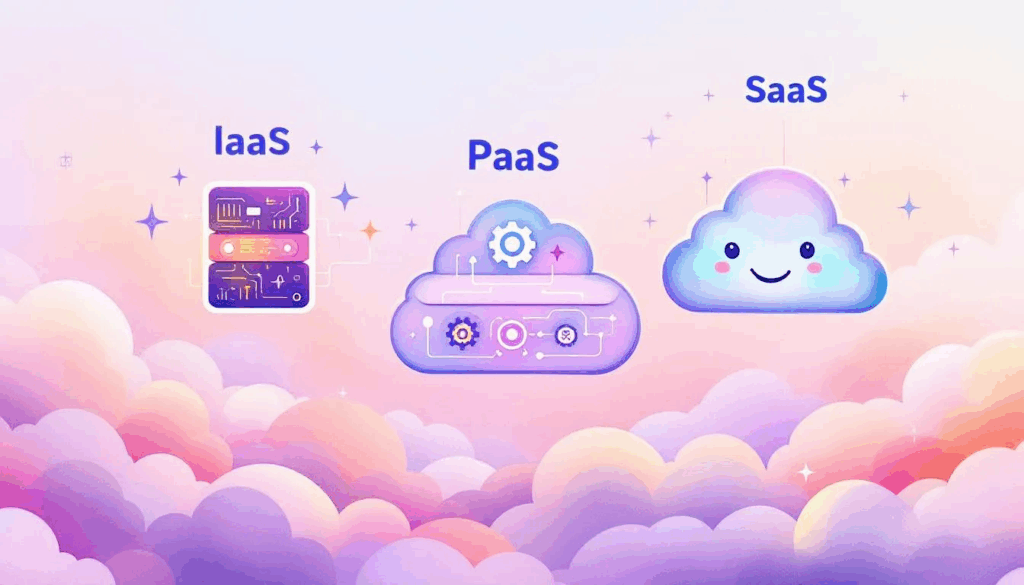
Cloud computing services fall into three main categories, which are types of cloud: Infrastructure as a Service (IaaS), Platform as a Service (PaaS), and Software as a Service (SaaS). Each model represents a different layer of cloud computing solutions, offering varying levels of control, flexibility, and management.
The three main cloud service models are:
IaaS (Infrastructure as a Service): Provides the most basic cloud services, offering virtualized computing resources over the internet.
PaaS (Platform as a Service): Builds on IaaS by providing a platform for developers to create and deploy applications without managing the underlying infrastructure.
SaaS (Software as a Service): The most comprehensive model, delivering software applications over the internet, eliminating the need for local installations and maintenance.
Infrastructure as a Service (IaaS)
Infrastructure as a Service (IaaS) offers businesses access to virtualized computing resources over the internet through APIs. This model allows organizations to scale their IT resources up or down as needed without significant capital expenditure, making it a cost-effective solution for growing businesses.
Cloud platforms facilitate faster application development by providing on-demand infrastructure, enabling developers to focus on writing code rather than managing hardware. This is particularly beneficial in sectors like healthcare, where IaaS is the fastest-growing cloud service model, with a projected compound annual growth rate of 32 percent by 2027, especially for cloud applications.
IaaS providers, such as AWS, Google Cloud, and Microsoft Azure, offer additional resources that enhance the overall functionality and security of cloud environments, including:
Virtual machine disk-image libraries
Storage options
Firewalls
Load balancers
Platform as a Service (PaaS)
Platform as a Service (PaaS) simplifies the application development process by providing a comprehensive environment for developers to create, test, and deploy applications without managing the underlying infrastructure. PaaS includes development environments, platforms, and tools essential for building applications, streamlining the coding process and reducing time to market.
Google Cloud offers several tools to enhance development:
Cloud Code: for writing and debugging cloud-native applications, making the development process more efficient.
Gemini code assistance: helps developers with app development by providing functionality that streamlines coding tasks.
Vertex AI: used for building and scaling generative AI apps.
PaaS vendors like Google Cloud and Microsoft Azure typically offer:
A comprehensive development environment
Toolkit
Standards for development
Channels for distributing applications
These offerings make it easier for developers to focus on innovation rather than infrastructure management.
Software as a Service (SaaS)
Software as a Service (SaaS) allows users to access software applications over the internet without the need for local installations. This model is akin to renting a house, where users gain access to the software without owning it, providing flexibility and ease of use.
SaaS applications and mobile apps are hosted on the cloud and accessed via the internet, making them convenient and accessible from anywhere with an internet connection. Users typically subscribe on a monthly or annual basis, benefiting from automatic updates and maintenance, ensuring they always have access to the latest features and security enhancements.
Popular examples of SaaS applications include Google Workspace, Microsoft 365, and Salesforce, which offer a range of tools and services that cater to various business needs.
Deployment Models of Cloud Computing

Cloud deployment models determine how cloud services are made available to users and who controls the infrastructure. The main deployment models are:
Public cloud
Private cloud
Hybrid cloud
Multi-cloud.
Public clouds offer scalable and cost-effective solutions, while private clouds provide enhanced control and security. Hybrid clouds combine the benefits of both public and private clouds environments, and multi-cloud strategies involve using services from multiple public clouds to avoid vendor lock-in and enhance reliability.
Public Cloud
Public cloud services refer to computing resources and services made available to the public via the Internet, allowing organizations to access scalable and efficient infrastructure without the need for local hardware. The benefits of public cloud services include lower costs, enhanced scalability, and flexibility, enabling organizations to only pay for what they use.
Common use cases for public cloud services include hosting websites, data storage and backup, and application development, providing versatility across various industries. However, security considerations are crucial, involving measures such as data encryption and access controls to ensure data privacy and compliance with regulations.
Public cloud providers like AWS, Google Cloud, and Microsoft Azure, along with many cloud providers, offer a range of services as a service provider that cloud providers offer to cater to different business needs, making it easier for organizations to adopt cloud computing.
Private Cloud
A private cloud is a cloud infrastructure used exclusively by one organization, offering enhanced control over data and resources. This model provides dedicated resources for a single organization, enhancing security and compliance with industry regulations.
Private clouds are ideal for businesses that require high levels of security and control, such as financial institutions and healthcare organizations. Maintaining their own cloud infrastructure ensures that data and applications are protected from external threats.
Hybrid Cloud
A hybrid cloud combines public cloud and private cloud environments, allowing data and applications to be shared between them for better resource management. This model offers the flexibility to use public cloud resources for non-sensitive tasks while keeping sensitive data in a private cloud environment.
Hybrid clouds enable businesses to optimize their IT resources, providing the scalability of public clouds and the security of private clouds. This hybrid cloud model is particularly useful for organizations with varying workload demands and regulatory requirements.
Multi-Cloud
Multi-cloud strategies involve using multiple cloud services from different providers to optimize performance and avoid vendor lock-in. Leveraging services from multiple providers enhances reliability and prevents dependency on a single vendor.
Multi-cloud approaches allow businesses to select the best services for their specific needs, whether it’s for data storage, application development, or disaster recovery. This flexibility ensures that organizations can adapt to changing business requirements and technological advancements.
Benefits of Cloud Computing

Cloud computing offers numerous benefits that make it an attractive option for businesses of all sizes. One of the most significant advantages is low cost savings. Utilizing cloud resources allows organizations to sidestep significant upfront costs for purchasing and maintaining physical hardware, shifting towards an operational expenditure model that offers greater financial flexibility.
Scalability is another key benefit of cloud computing. Businesses can easily scale their IT resources up or down based on demand, ensuring they have the necessary computing capacity to handle varying workloads. This flexibility is crucial for organizations that experience seasonal or unpredictable spikes in demand, allowing for virtually unlimited scale.
Cloud computing also simplifies data backup and disaster recovery, making it easier and less expensive for organizations to protect their cloud storage data transfer. With cloud-based solutions, businesses can quickly recover from disruptions and ensure business continuity.
Moreover, cloud technology acts as a catalyst to accelerate innovation. Integrating advanced practices and a range of services through cloud computing and cloud bursting streamlines operations, enhances productivity, and drives growth.
Challenges in Cloud Computing
While cloud computing offers many advantages, it also presents several challenges that organizations must address. Data security and privacy are significant concerns, as cloud services involve storing data and processing of sensitive data on remote servers managed by third-party providers. Ensuring that stored data is protected from unauthorized access and complies with regulations like GDPR is crucial for businesses.
Another challenge is cost management. The complex pricing structures of cloud services can make it difficult for organizations to track their true cloud costs, leading to unforeseen expenses. Effective cost management strategies, such as regular budget reviews and the use of cloud optimization tools, can help organizations control spending and enhance resource allocation.
Vendor lock-in is also a concern, as relying on a single cloud provider can limit flexibility and increase costs over time. Adopting a multi-cloud approach can mitigate this risk by allowing organizations to leverage services from multiple providers, enhancing reliability and preventing dependency on a single vendor.
Cloud Security and Data Protection

Cloud security and data protection are paramount for organizations using cloud services. Public cloud services, accessible to anyone over the internet, pose potential security risks due to the sharing of resources among multiple customers. Cloud providers mitigate these risks by implementing robust security measures including encryption, firewalls, and network segmentation.
Solutions like Cloud Armor protect against denial of service and web attacks, enhancing the security of internet properties. Additionally, web application firewalls provided by providers like Cloudflare offer an extra layer of protection against cyber threats.
Privacy concerns can be addressed through policy and legislation, user choices, data encryption, and identity management systems. Security concerns related to identity management systems are crucial for distinguishing authorized users from unauthorized ones and determining data access levels. Providers manage infrastructure security, while customers handle data encryption and identity access management.
Implementing these security features and maintaining a secure perimeter protect data in the cloud and ensure compliance with industry regulations.
Industry Applications of Cloud Computing
Cloud computing has a wide range of applications across various industries, transforming how businesses operate and innovate. In healthcare, for example, cloud technology enables providers to analyze unstructured data quickly through data analytics, improving decision-making and patient care. Global spending on cloud technology in healthcare is projected to exceed $89 billion by 2027, highlighting its growing importance.
Cloud solutions in healthcare offer several advantages:
Allow healthcare professionals to access detailed patient data from various sources, enhancing treatment accuracy and efficiency.
Enable companies like Microsoft and Amazon to collaborate with healthcare organizations to enhance clinical trial processes through cloud technology.
Streamline supply chain processes via cloud-based platforms, improving visibility and operational efficiency.
Beyond healthcare, cloud computing supports:
Electronic health record management
Telehealth applications
Automation of backend operations These applications significantly improve the efficiency of healthcare delivery.
Future Trends in Cloud Computing
The future of cloud computing is shaped by emerging trends that promise to further revolutionize the industry. A strategic approach to cloud migration allows companies to harness the potential of data and AI, enhancing decision-making and operational efficiency. Gartner predicts that by 2025, investment in public cloud services will surpass that of traditional IT, underscoring the growing adoption of cloud technologies.
Serverless computing is gaining traction, allowing companies to build applications without managing servers, thereby enhancing efficiency and reducing operational complexity. Quantum computing, though still in its early stages, has the potential to transform data processing capabilities, offering unprecedented computing power.
Sustainability is also becoming a key focus in cloud computing, with companies striving to minimize their carbon footprints and adopt eco-friendly practices. These trends indicate a promising future for cloud computing, driving innovation and growth across industries.
Summary
In summary, cloud computing has emerged as a transformative force in the technology landscape, offering unparalleled benefits in terms of cost savings, scalability, flexibility, and innovation. By leveraging cloud services, organizations can access diverse IT resources, streamline their operations, and drive growth without the need for significant upfront investments.
As we look to the future, the continued evolution of cloud technologies promises even greater advancements in areas such as serverless computing, quantum computing, and sustainability. By staying informed and adopting strategic cloud migration approaches, businesses can harness the full potential of cloud computing to achieve their goals and maintain a competitive edge in the digital age.
Frequently Asked Questions
What is cloud computing?
Cloud computing is the provision of IT resources via the internet, enabling organizations to utilize computing power, storage, and applications without relying on physical infrastructure. This approach enhances efficiency and scalability for businesses.
What are the main cloud service models?
The main cloud service models are Infrastructure as a Service (IaaS), Platform as a Service (PaaS), and Software as a Service (SaaS), each providing varying degrees of control and management for users. Understanding these models is crucial for selecting the right cloud solution for your needs.
How does cloud computing enhance security?
Cloud computing enhances security through the implementation of robust measures by providers, including encryption, firewalls, and identity management systems. This comprehensive approach helps protect data and ensures compliance, while customers must manage their own data encryption and access controls.
What are the benefits of using a multi-cloud strategy?
Adopting a multi-cloud strategy enhances reliability and mitigates vendor lock-in, enabling organizations to choose the best services tailored to their specific needs. This approach ultimately fosters greater flexibility and resilience in cloud operations.
What future trends are expected in cloud computing?
The future of cloud computing is expected to be shaped by trends such as serverless computing, quantum computing, and a heightened emphasis on sustainability, all of which will enhance innovation and operational efficiency across various sectors.